Saturday, March 5, 2016

Cloud computing, also known as 'on-demand computing', is a kind of Internet-based computing, where shared resources, data and information are provided to computers and other devices on-demand. It is a model for enabling ubiquitous, on-demand access to a shared pool of configurable computing resources. Cloud computing and storage solutions provide users and enterprises with various capabilities to store and process their data in third-party data centers. It relies on sharing of resources to achieve coherence and economies of scale, similar to a utility (like the electricity grid) over a network. At the foundation of cloud computing is the broader concept of converged infrastructure and shared services.
Cloud computing is a model for enabling ubiquitous, convenient, on-demand network access to a shared pool of configurable computing resources (e.g., networks, servers, storage, applications and services) that can be rapidly provisioned and released with minimal management effort.
Proponents claim that cloud computing allows companies to avoid upfront infrastructure costs, and focus on projects that differentiate their businesses instead of on infrastructure.Proponents also claim that cloud computing allows enterprises to get their applications up and running faster, with improved manageability and less maintenance, and enables IT to more rapidly adjust resources to meet fluctuating and unpredictable business demand. Cloud providers typically use a "pay as you go" model. This can lead to unexpectedly high charges if administrators do not adapt to the cloud pricing model.
The present availability of high-capacity networks, low-cost computers and storage devices as well as the widespread adoption of hardware virtualizationservice-oriented architecture, and autonomic and utility computing have led to a growth in cloud computing. Companies can scale up as computing needs increase and then scale down again as demands decrease.
Cloud computing has now become a highly demanded service or utility due to the advantages of high computing power, cheap cost of services, high performance, scalability, accessibility as well as availability. Cloud vendors are experiencing growth rates of 50% per annum. But due to being in a stage of infancy, it still has some pitfalls which need to be given proper attention to make cloud computing services more reliable and user friendly
Google Cloud Platform is a cloud computing platform by Google that offers hosting on the same supporting infrastructure that Google uses internally for end-user products like Google Search and YouTube. Cloud Platform provides developer products to build a range of programs from simple websites to complex applications.
Google Cloud Platform is a part of a suite of enterprise solutions from Google for Work and provides a set of modular cloud-based services with a host of development tools. For example, hosting and computing, cloud storage, data storage, translations APIs and prediction APIs.

Products

The Google Cloud Platform is composed of a family of products, each including a web interface, a command-line tool and a REST API.
  • Google App Engine is a Platform as a Service for sandboxed web applications. App Engine offers automatic scaling with resources increased automatically to handle server load.
  • Google Compute Engine is the Infrastructure as a Service component of the Google Cloud Platform that enables users to launch virtual machines (VMs) on demand.
  • Google Container Engine makes it easy to run Docker containers on Google Cloud Platform.
  • Google Cloud Storage is an online storage service for files.
  • Google Cloud Bigtable is a fast, fully managed, massively scalable NoSQL database service that's ideal for web, mobile, and Internet of Things applications requiring terabytes to petabytes of data.
  • Google Cloud Datastore is a fully managed, highly available NoSQL data storage for non-relational data that includes a REST API.
  • Google Cloud SQL is a fully managed MySQL database that lives in the Google Cloud infrastructure.
  • Google Load Balancing balances traffic between Compute Engine instances, using either HTTP or Network (TCP/UDP)
  • Google Interconnect connects your network to Google’s directly or via your carrier or VPN
  • Google Cloud DNS is a DNS service hosted in the Google Cloud infrastructure.
  • Google BigQuery is a data analysis tool that uses SQL-like queries to process big datasets in seconds.
  • Google Dataflow enables reliable execution for large scale data processing scenarios such as Extract, Transform, Load (ETL), analytics, real-time computation, and process orchestration.
  • Google Cloud Pub/Sub connects your services with reliable, many-to-many, asynchronous messaging hosted on Google's infrastructure.
  • Google Cloud Endpoints is a tool to create services inside App Engine that can be easily connected from iOS, Android and JavaScript clients.
  • Google Translate API is a way to create multilingual apps and translate text into other languages programmatically. Thousands of language pairs are available.
  • Google Prediction API uses Google’s machine learning algorithms to analyze data and predict future outcomes using a familiar RESTful interface.
  • Google Cloud Monitoring gains insight into the performance and availability of your cloud-powered applications.
  • Google Cloud Logging manages all your log data for Compute Engine and App Engine to investigate and debug system issues, gain operational and business insights, and meet security and compliance needs.
  • Google Cloud Deployment Manager allows developers to easily design, share, deploy and manage complex Cloud Platform solutions using a simple, declarative templates.
Pay per click (PPC), also called cost per click, is an internet advertising model used to direct traffic to websites, in which advertisers pay the publisher (typically a website owner or a host of website) when the ad is clicked. It is defined simply as “the amount spent to get an advertisement clicked.”
With search engines, advertisers typically bid on keyword phrases relevant to their target market. Content sites commonly charge a fixed price per click rather than use a bidding system. PPC "display" advertisements, also known as "banner" ads, are shown on web sites or search engine results with related content that have agreed to show ads.
In contrast to the generalized portal, which seeks to drive a high volume of traffic to one site, PPC implements the so-called affiliate model, which provides purchase opportunities wherever people may be surfing. It does this by offering financial incentives (in the form of a percentage of revenue) to affiliated partner sites. The affiliates provide purchase-point click-through to the merchant. It is a pay-for-performance model: If an affiliate does not generate sales, it represents no cost to the merchant. Variations include banner exchange, pay-per-click, and revenue sharing programs.
Websites that utilize PPC ads will display an advertisement when a keyword query matches an advertiser's keyword list, or when a content site displays relevant content. Such advertisements are called sponsored links or sponsored ads, and appear adjacent to, above, or beneath organic results on search engine results pages, or anywhere a web developer chooses on a content site.
The PPC advertising model is open to abuse through click fraud, although Google and others have implemented automated systems to guard against abusive clicks by competitors or corrupt web developers.

Purpose[edit]

Pay-per-click, along with cost per impression and cost per order, are used to assess the cost effectiveness and profitability of internet marketing. Pay-per-click has an advantage over cost per impression in that it tells us something about how effective the advertising was. Clicks are a way to measure attention and interest. If the main purpose of an ad is to generate a click, then pay-per-click is the preferred metric. Once a certain number of web impressions are achieved, the quality and placement of the advertisement will affect click through rates and the resulting pay-per-click.[1]

Construction[edit]

Pay-per-click is calculated by dividing the advertising cost by the number of clicks generated by an advertisement. The basic formula is:
Pay-per-click ($) = Advertising cost ($) ÷ Ads clicked (#)[1]
There are two primary models for determining pay-per-click: flat-rate and bid-based. In both cases, the advertiser must consider the potential value of a click from a given source. This value is based on the type of individual the advertiser is expecting to receive as a visitor to his or her website, and what the advertiser can gain from that visit, usually revenue, both in the short term as well as in the long term. As with other forms of advertising targeting is key, and factors that often play into PPC campaigns include the target's interest (often defined by a search term they have entered into a search engine, or the content of a page that they are browsing), intent (e.g., to purchase or not), location (for geo targeting), and the day and time that they are browsing.

Flat-rate PPC[edit]

In the flat-rate model, the advertiser and publisher agree upon a fixed amount that will be paid for each click. In many cases the publisher has a rate card that lists the pay-per-click (PPC) within different areas of their website or network. These various amounts are often related to the content on pages, with content that generally attracts more valuable visitors having a higher PPC than content that attracts less valuable visitors. However, in many cases advertisers can negotiate lower rates, especially when committing to a long-term or high-value contract.
The flat-rate model is particularly common to comparison shopping engines, which typically publish rate cards.[5] However, these rates are sometimes minimal, and advertisers can pay more for greater visibility. These sites are usually neatly compartmentalized into product or service categories, allowing a high degree of targeting by advertisers. In many cases, the entire core content of these sites is paid ads.

Bid-based PPC

The advertiser signs a contract that allows them to compete against other advertisers in a private auction hosted by a publisher or, more commonly, an advertising network. Each advertiser informs the host of the maximum amount that he or she is willing to pay for a given ad spot (often based on a keyword), usually using online tools to do so. The auction plays out in an automated fashion every time a visitor triggers the ad spot.
When the ad spot is part of a search engine results page (SERP), the automated auction takes place whenever a search for the keyword that is being bid upon occurs. All bids for the keyword that target the searcher's geo-location, the day and time of the search, etc. are then compared and the winner determined. In situations where there are multiple ad spots, a common occurrence on SERPs, there can be multiple winners whose positions on the page are influenced by the amount each has bid. The bid and Quality Score are used to give each advertise's advert an ad rank. The ad with the highest ad rank shows up first. The predominant three match types for both Google and Bing are broad, exact and phrase match. Google also offers the broad modifier match type which differs from broad match in that the keyword must contain the actual keyword terms in any order and doesn't include relevant variations of the terms.
In addition to ad spots on SERPs, the major advertising networks allow for contextual ads to be placed on the properties of 3rd-parties with whom they have partnered. These publishers sign up to host ads on behalf of the network. In return, they receive a portion of the ad revenue that the network generates, which can be anywhere from 50% to over 80% of the gross revenue paid by advertisers. These properties are often referred to as a content network and the ads on them ascontextual ads because the ad spots are associated with keywords based on the context of the page on which they are found. In general, ads on content networks have a much lower click-through rate (CTR) and conversion rate (CR) than ads found on SERPs and consequently are less highly valued. Content network properties can include websites, newsletters, and e-mails.
Advertisers pay for each click they receive, with the actual amount paid based on the amount bid. It is common practice amongst auction hosts to charge a winning bidder just slightly more (e.g. one penny) than the next highest bidder or the actual amount bid, whichever is lower. This avoids situations where bidders are constantly adjusting their bids by very small amounts to see if they can still win the auction while paying just a little bit less per click.
To maximize success and achieve scale, automated bid management systems can be deployed. These systems can be used directly by the advertiser, though they are more commonly used by advertising agencies that offer PPC bid management as a service. These tools generally allow for bid management at scale, with thousands or even millions of PPC bids controlled by a highly automated system. The system generally sets each bid based on the goal that has been set for it, such as maximize profit, maximize traffic at breakeven, and so forth. The system is usually tied into the advertiser's website and fed the results of each click, which then allows it to set bids. The effectiveness of these systems is directly related to the quality and quantity of the performance data that they have to work with — low-traffic ads can lead to a scarcity of data problem that renders many bid management tools useless at worst, or inefficient at best.

What is PPC?

PPC stands for pay-per-click, a model of internet marketing in which advertisers pay a fee each time one of their ads is clicked. Essentially, it’s a way of buying visits to your site, rather than attempting to “earn” those visits organically.
Search engine advertising is one of the most popular forms of PPC. It allows advertisers to bid for ad placement in a search engine's sponsored links when someone searches on a keyword that is related to their business offering. For example, if we bid on the keyword “PPC software,” our ad might show up in the very top spot on the Google results page.
What is PPC
Every time our ad is clicked, sending a visitor to our website, we have to pay the search engine a small fee. When PPC is working correctly, the fee is trivial, because the visit is worth more than what you pay for it. In other words, if we pay $3 for a click, but the click results in a $300 sale, then we’ve made a hefty profit.
A lot goes into building a winning PPC campaign: from researching and selecting the right keywords, to organizing those keywords into well-organized campaigns and ad groups, to setting up PPC landing pages that are optimized for conversions. Search engines reward advertisers who can create relevant, intelligently targeted pay-per-click campaigns by charging them less for ad clicks. If your ads and landing pages are useful and satisfying to users, Google charges you less per click, leading to higher profits for your business. So if you want to start using PPC, it’s important to learn how to do it right.

What is Google AdWords?

Google AdWords is the single most popular PPC advertising system in the world. The AdWords platform enables businesses to create ads that appear on Google’s search engine and other Google properties.
AdWords operates on a pay-per-click model, in which users bid on keywords and pay for each click on their advertisements. Every time a search is initiated, Google digs into the pool of AdWords advertisers and chooses a set of winners to appear in the valuable ad space on its search results page. The “winners” are chosen based on a combination of factors, including the quality and relevance of their keywords and ad campaigns, as well as the size of their keyword bids.
More specifically, who gets to appear on the page is based on and advertiser’s Ad Rank, a metric calculated by multiplying two key factors – CPC Bid (the highest amount an advertiser is willing to spend) and Quality Score (a value that takes into account your click-through rate, relevance, and landing page quality). This system allows winning advertisers to reach potential customers at a cost that fits their budget. It’s essentially a kind of auction. The below infographic illustrates how this auction system works.
Conducting PPC marketing through AdWords is particularly valuable because, as the most popular search engine, Google gets massive amounts of traffic and therefore delivers the most impressions and clicks to your ads. How often your PPC ads appear depends on which keywords and match types you select. While a number of factors determine how successful your PPC advertising campaign will be, you can achieve a lot by focusing on:
  • Keyword Relevance – Crafting relevant PPC keyword lists, tight keyword groups, and proper ad text.
  • Landing Page Quality – Creating optimized landing pages with persuasive, relevant content and a clear call-to-action, tailored to specific search queries.
  • Quality Score – Quality Score is Google's rating of the quality and relevance of your keywords, landing pages, and PPC campaigns. Advertisers with better Quality Scores get more ad clicks at lower costs.

PPC Keyword Research

Keyword research for PPC can be incredibly time-consuming, but it is also incredibly important. Your entire PPC campaign is built around keywords, and the most successful AdWords advertisers continuously grow and refine their PPC keyword list. If you only do keyword research once, when you create your first campaign, you are probably missing out on hundreds of thousands of valuable, long-tail, low-cost and highly relevant keywords that could be driving traffic to your site.
An effective PPC keyword list should be:
  • Relevant – Of course, you don't want to be paying for Web traffic that has nothing to do with your business. You want to find targeted keywords that will lead to a higher PPC click-through rate, effective cost per click, and increased profits. That means the keywords you bid on should be closely related to the offerings you sell.
  • Exhaustive – Your keyword research should include not only the most popular and frequently searched terms in your niche, but also to the long tail of search. Long-tail keywords are more specific and less common, but they add up to account for the majority of search-driven traffic. In addition, they are less competitive, and therefore less expensive.
  • Expansive - PPC is iterative. You want to constantly refine and expand your campaigns, and create an environment in which your keyword list is constantly growing and adapting.

Managing Your PPC Campaigns

Once you've created your new campaigns, you’ll need to manage them regularly to make sure they continue to be effective. In fact, regular account activity is one of the best predictors of account success. You should be continuously analyzing the performance of your account and making the following adjustments to optimize your campaigns:
  • Add PPC Keywords: Expand the reach of your PPC campaigns by adding keywords that are relevant to your business.
  • Add Negative Keywords: Add non-converting terms as negative keywords to improve campaign relevancy and reduce wasted spend.
  • Split Ad Groups: Improve click-through rate (CTR) and Quality Score by splitting up your ad groups into smaller, more relevant ad groups, which help you create more targeted ad text and landing pages.
  • Review Costly PPC Keywords: Review expensive, under-performing keywords and shut them off if necessary.
  • Refine Landing Pages: Modify the content and calls-to-action (CTAs) of your landing pages to align with individual search queries in order to boost conversion rates. Don’t send all your traffic to the same page.
You’ll learn more about all of these elements of PPC campaign management as you move forward through the coursework in PPC University.
If you’re ready to get started with PPC, skip ahead to learn how to set up an AdWords account.
If you’ve already got an AdWords account, we suggest you use our FREE AdWords Performance Grader to help you zero in on areas of improvement. In 60 seconds or less, you’ll receive a customized report grading your account performance in 9 key areas, including click-through rate, Quality Score and account activity.
Google AdWords is an online advertising service that enables advertisers to compete to display brief advertising copyto web users, based in part on keywords, predefined by the advertisers, that might link the copy to the content of web pages shown to users. Web pages from Google and from partner websites are designed to allow Google to select and display this advertising copy. Advertisers pay when users divert their browsing to seek more information about the copy displayed, and partner websites receive a portion of the income they generate.
AdWords has evolved into Google's main source of revenue. Google's total advertising revenues were USD $43.7 billion in 2012. AdWords offers pay-per-click (PPC), that is, cost-per-click (CPC) advertising, cost-per-acquisition (CPA) advertising, cost-per-thousand-impressions or cost per mille (CPM) advertising, site-targeted advertising for text, banner, and rich-media ads, and remarketing (also known as retargeting). The AdWords program includes local, national, and international distribution. Google's text advertisements are short, consisting of one headline of 25 characters, two additional text lines of 35 characters each, and a display URL of 35 characters. Image ads can be one of several different Interactive Advertising Bureau (IAB) standard sizes.
Sales and support for Google's AdWords division in the United States is based in Mountain View, California, with major secondary offices in Ann Arbor, Michigan and New York. The third-largest US facility is in Mountain View, California, headquarters. Engineering for Google AdWords is based in Mountain View, California with major secondary offices in Los Angeles and New York.
Google has an active official public help and support community maintained and frequented by highly experienced Adwords users (referred to as "Top Contributors") and Google employees

How it works

With Google AdWords, you can reach people as they search for words or phrases (which we call keywords
) or browse websites with themes related to your business. Your ad can appear on Google and its partner websites. With cost-per-click (CPC) bidding, you're charged only when someone clicks your ad.

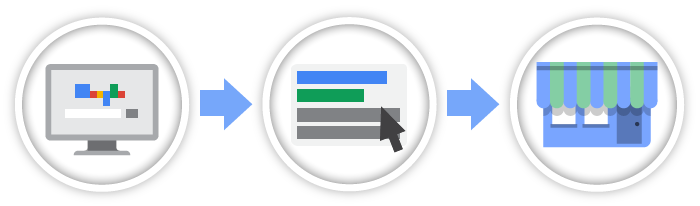
Search Advertising Process
Your ads appear beside relevant content
People click on your ads
And connect to your business

Example

Let's say you run a bicycle repair shop near Boston. Set your ad to appear to customers in just that location, and when someone living or visiting there searches Google for "bike repair near Boston," they could see your ad and click it to connect to your business.

Benefits

A few important things set AdWords apart from other kinds of advertising. Using AdWords, you can:
Computer screen
Reach people searching for what you offer
  • Your ad is displayed to people who are already searching for the kinds of products and services you offer. So those people are more likely to take action.
  • You can choose where your ad appears -- on which specific websites and in which geographical areas (states, towns, or even neighborhoods).
  • The Google Display Network   alone reaches over 90% of Internet users worldwide (Source: comScore).
Calculator and money
Control your budget
  • With cost-per-click (CPC) bidding, you’re charged only when someone clicks your ad, not when your ad appears. There are a variety of bidding options you can choose from.
  • You decide how much or little you want to spend monthly, and you’ll never be charged more than that amount.
  • There’s no minimum spending commitment.
Graph
See what's working in your ad, and build on it
  • View a report of how your ad is doing -- see how many new customers connect to your business from your ad, where they’re coming from, and more.
  • Use AdWords tools to edit and improve your ad, and increase the number of potential customers who contact your business.

Thursday, March 3, 2016

IBM cloud computing is using for a set of cloud computing services for business offered by the information technology company IBM. All offerings used to be marketed under the name IBM SmartCloud. IBM cloud includes infrastructure as a service (IaaS), software as a service (SaaS) and platform as a service (PaaS) offered through public, private and hybrid cloud delivery models, in addition to the components that make up those clouds.

Overview

IBM cloud computing model
IBM offers three hardware platforms for cloud computing. These platforms offer built-in support forvirtualization. For virtualization IBM offers IBM Websphere application infrastructure solutions that support programming models and open standards for virtualization.
The management layer of the IBM cloud framework includes IBM Tivoli middleware. Management tools provide capabilities to regulate images with automated provisioning and de-provisioning, monitor operations and meter usage while tracking costs and allocating billing. The last layer of the framework provides integrated workload tools. Workloads for cloud computing are services or instances of code that can be executed to meet specific business needs. IBM offers tools for cloud based collaboration, development and test, application development, analytics, business-to-business integration, and security.

History

IBM cloud computing emerged from the union of its mainframe computing and virtualization technologies. Known as the original virtualization company, IBM’s first experiments in virtualization occurred in the 1960s with the development of the virtual machine (VM) on CP-40 and CP-67 operating systems. CP-67, ahypervisor used for software testing and development, enabled memory sharing across VMs while giving each user their own virtual memory space. With the machine partitioned into separate VMs, mainframes could run multiple applications and processes at the same time, making the hardware more efficient and cost-effective.[7] IBM began selling VM technology for the mainframe in 1972.
In February 1990, IBM released POWER processor based servers. The servers, in combination with the IBM mainframe, were built for complex and mission-critical virtualization. Power systems servers include PowerVMhypervisors with live partition mobility and active memory sharing. Live migration was introduced withPOWER6 in May 2007. Next, IBM looked to implement standardization and automation in their technology in order to keep up with the proliferation of data produced by increasingly efficient hardware and data centers. This combination of virtualization, standardization and automation led to the development of IBM cloud computing.
IBM began to develop a strategy for cloud computing in 2007, announcing that it planned to build clouds for enterprise clients and provide services to fill what it regarded as gaps in existing cloud environments. In October 2007, IBM announced a partnership with Google to promote cloud computing in universities. In addition to donating hardware and machines, the two companies also provided a curriculum to teach students about cloud computing.
IBM claimed in April 2011 that 80% of Fortune 500 companies were using IBM cloud, and that their software and services were used by more than 20 million end-user customers, with clients including American AirlinesAvivaCarfaxFrito-LayIndiaFirst Life Insurance Company, and 7-Eleven.
On 4 June 2013 IBM announced its acquisition of SoftLayer, to form an IBM Cloud Services Division.

IBM SmartCloud (or IBM Cloud)

The IBM SmartCloud brand includes infrastructure as a service, software as a service and platform as a service offered through public, private and hybrid cloud delivery models. IBM places these offerings under three umbrellas: SmartCloud Foundation, SmartCloud Services and SmartCloud Solutions.[14]
SmartCloud Foundation consists of the infrastructure, hardware, provisioning, management, integration and security that serve as the underpinnings of a private or hybrid cloud. Built using those foundational components, PaaS, IaaS and backup services make up SmartCloud Services. Running on this cloud platform and infrastructure, SmartCloud Solutions consist of a number of collaboration, analytics and marketing SaaS applications.
IBM also builds cloud environments for clients that are not necessarily on the SmartCloud Platform. For example, features of the SmartCloud platform—such as Tivoli management software or IBM Systems Director virtualization—can be integrated separately as part of a non-IBM cloud platform. The SmartCloud platform consists solely of IBM hardware, software, services and practices.
IBM SmartCloud Enterprise and SmartCloud Enterprise+ compete with products like those of Rackspace and Amazon Web Services. Erich Clementi, vice president of Global Technology Services at IBM, said in 2012 that the goal with SmartCloud Enterprise and SmartCloud Enterprise+ was to provide an Amazon EC2-like experience primarily for test and development purposes and to provide a more robust experience for production workloads.
In 2011, IBM SmartCloud integrated Hadoop-based InfoSphere BigInsights for big data, Green Hat for software testing and Nirvanix for cloud storage. In 2012, the then new CEO Virginia Rometty said the company planned to spend $20 billion on acquisitions by 2015.
Users may build their own private cloud or purchase services hosted on the IBM cloud. Users may also purchase IBM hardware, software and services to build their customized cloud environment.
By 2014, the name SmartCloud has been replaced with products that have a prefix of "IBM Cloud". A product called IBM Cloud Manager with OpenStack would be IBM's integration of OpenStack along with a multitude of value additions that would serve enterprise customers. A product called IBM Cloud Orchestrator would serve the orchestration needs of an enterprise. The aforementioned SmartCloud products have been discontinued.

Public, private and hybrid cloud models

IBM offers cloud delivery options including solely private cloud, solely public cloud, and variations in between. Private, public and hybrid clouds are not strictly distinct, as IBM allows the option to build a customized cloud solution out of a combination of public cloud and private cloud elements. Companies that prefer to keep all data and processes behind their own firewall can use private cloud services managed by their own IT staff. A company may also choose pay-as-you-go pricing. Hybrid cloud options allow for some processes to be hosted and managed by IBM, while others are kept on a private cloud or on a VPN or VLAN. IBM also offers planning and consultation throughout the deployment process. IBM offers five cloud provision models:
  • Private cloud, owned and operated by the customer
  • Private cloud, owned by the customer, but operated by IBM (or another provider)
  • Private cloud, owned and operated by IBM (or another provider)
  • Virtual private cloud services (based on multi-tenanted support for individual enterprises)
  • Public cloud services (based on the provision of functions to individuals)
The majority of cloud users choose a hybrid cloud model, with some workloads being served by internal systems, some from commercial cloud providers and some from public cloud service providers.
On August 25, 2011, IBM announced the release of a new hybrid cloud model orchestrated by IBM WebSphere Cast Iron integration of on- and off-premises resources.Enterprises can use Cast Iron integration to link their public cloud appliances— hosted on environments like Amazon EC2Google AppsSalesforce.comOracle CRM,SugarCRM and a number of others—to their existing systems or in-house, private cloud environments. Cast Iron Integration aims to reduce the time and effort needed for customized coding, in favor of simple workload provisioning through Tivoli.
The IBM public cloud offering, SmartCloud Enterprise, was launched on April 7, 2011. SCE is hosted IaaS with service level agreements (SLA)s, and can be offered in a private, public or hybrid model. The environment is hosted on IBM servers (System p or System x), with a standard set of software images to choose from.
For customers who perceive that the security risk of cloud computing adoption is too high, IBM offers private cloud services. IDEAS International wrote in a white paper, “IBM believes that its clients are currently more comfortable with private clouds than public or hybrid clouds, and that many are ready to deploy fundamental business applications in private clouds.” For building strictly private clouds, IBM offers IBM Workload Deployer and Cloudburst as ready-to-deploy, “cloud in a box” style solutions. Cloudburst provides blade servers, middleware and virtualization for an enterprise to build its own cloud-ready virtual machines. Workload Deployer connects an enterprise’s existing servers to virtualization components and middleware in order to help deploy standardized virtual machines designed by IBM. For customers who prefer to perform their own integration of private clouds, IBM offers a choice of hardware and software building blocks, along with recommendations and a reference architecture, prior to deployment. Clients may choose from IBM virtualization-enabled servers, middleware and SaaS applications.

Cloud standards

IBM participates in several cloud standards initiatives within various standards development organizations involved in cloud service models IaaS, PaaS and SaaS, all of which work toward improvements in cloud interoperability and security.
IBM is a member of The Open Group, a council that works for the development of open, vendor-neutral IT standards and certifications. Other members of the group include HP,OracleSAP and numerous others.[27] IBM contributed the Cloud Computing Reference Architecture in February 2011 to The Open Group as the basis of an industry-wide cloud architecture. IBM’s CCRA is based on real-world input from many cloud implementations across IBM. It is intended to be used as a blueprint/guide for architecting cloud implementations, driven by functional and non-functional requirements of the respective cloud implementation. HP and Microsoft have also published Cloud Computing Reference Architectures.
Within the IaaS space, IBM is a member of the Cloud Management Work Group (CMWG) within the Distributed Management Task Force (DMTF), which released a draft version of their IaaS APIs, called the Cloud Infrastructure Management Interface (CIMI), on September 14, 2011. The CIMI APIs define a logical model for the management of resources within the Infrastructure as a Service domain. With these APIs, clients can create, manage and connect machines, volumes and networks.
For PaaS and SaaS standards, IBM, Red HatCiscoCitrixEMC and others contribute to the Topology and Orchestration Specification for Cloud Applications (TOSCA) technical committee within Organization for the Advancement of Structured Information Standards (OASIS), which aims to provide a standardized way of managing the lifecycle of cloud services, for portability of cloud based applications. TOSCA's goal is to advance an interoperability standard that will make it easier to deploy cloud applications without vendor lock-in, while maintaining application requirements for security, governance, and compliance.
IBM participates in a number of cloud security related standards including the DMTF Cloud Auditing Data Federation (CADF) working group, and the OASIS Identity in the Cloud (IDCloud) technical committee. CADF is designed to address the need for a cloud provider to provide specific audit event, log and report information on a per-tenant and application basis. IDCloud aims to addresses the serious security challenges posed by identity management in cloud computing and investigates the need for profiles to achieve interoperability within current standards.
IBM founded the Cloud Standards Customer Council (CSCC) in April 2011, with the Object Management Group (OMG) Kaavo, Rackspace and Software AG, as an end user advocacy group that aimed to accelerate adoption of cloud services and eliminate barriers to security and interoperability associated with the transition to the cloud. In addition to contributing standards requirements to various standards development organizations (SDO), the CSCC also creates guides that companies can use on their own path to cloud adoption
Subscribe to RSS Feed Follow me on Twitter!